Showing posts with label School. Show all posts

Thursday, April 7, 2011

Poetry Book Review: "Sidman Poetry"

Citation:

Sidman, Joyce. 2010. Dark emperor & other poems of the night. Boston [Mass.]: Houghton Mifflin Books for Children. ISBN# 9780547152288.

Review:

Sidman explains the creatures that come out during the night in this poetry book. Dark Emperor is a great book for children that are able to learn about animals that they usually don’t see. The poems in this book teach children all the nocturnal happenings in the woods. Some of which children might be afraid of.

These topics include raccoons, snails, moths, rats, spiders, porcupines, crickets, mushrooms, bats, and other nightly creatures. In addition to the poems about these topics, Sidman includes a section next to the illustration of each poem detailing information about each creature. This added information gives children even more understanding of the animal or plant.

One of the poetic techniques that Sidman uses is repetition of certain words and lines. She also uses alliteration and consonance with her poetry. Sidman also is creative with the white space of a poem by shaping the words into the figure of an animal.

Dark Emperor beautifully illustrates rather ugly creatures of the night. One of this poetry book’s advantages is that you are able to read poems about such creepy characters in a peaceful way. For instance, “Snail at Moonrise” is described as “gleaming silver-bright”.

Poem: “Bat Wraps Up”


Belly full,
he drops down
from the echoing room of night.
One last swift swoop,
one last bug plucked from air
with cupped tail,
scooped neatly to mouth.

As dark grows thin
and body heavy,
he tumbles to tree
and grasps bark,
folds that swirl of cape
tipped with tiny claws
and snags the spot
that smells like home.

Then...upside flip,
lock-on grip...
stretch, hang, relax.
Yawn...

dawn.


Introducing the Poem:

I would introduce this poetry book before a science lesson. First, I would read the poem quietly and slowly. Towards the end of the poem, I would read the last stanza a little quicker with a faster rhythm. This gives it a little more sizzle and spark.

After reading the poem, I would ask the children what they thought about bats. This would raised questions about them being nocturnal and sleeping upside down, etc. This is a great segway to a science lesson.

Another great way to introduce this poem is right before a school field trip! In houston, there is a bridge where bats live under. Every few weeks out of the year at dusk thousand of bats fly out all at the same time. It is really neat to see. This would be beneficial to show the children because they the bats are just then waking up for their day.

I would also read to the students the extra side paragraph that explains the basic information of bats from "Bat Wraps Up" in Dark Emperor. By showing the children actual bats, they will better understand their nature. Introducing the poem this way can inspire the children to want to read more poetry. It could also lead them to want to learn more about science.

Poetry Book Review: "Hopkins Award Poetry"

Citation:


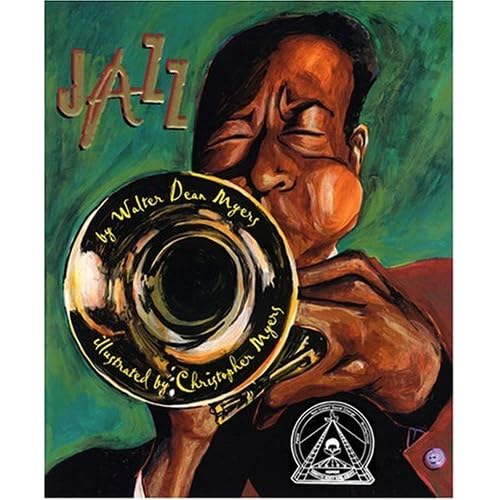
Myers, Walter Dean, and Christopher Myers. 2006. Jazz. New York: Holiday House. ISBN# 0823415457.

Review:

This poetry book is well recognized as a vibrant and enthusiastic peice of work. Myers uses poetry techniques such as rhythm, structure, and diction to create Jazz. The illustrations also add to create an exciting poetry book.

When reading a poem from Jazz, the reader instantly recognizes the rythym that has been strategically set in place. The words in the poetry act similar to muscial instruments. This poetry book would be a great way to introducte performance poetry to students.

Myers also uses poem structure to show different levels of his poetry. This helps break up the lines to better fit a song-like feel. In some poems, Myers repeats a stanza much like a chorus would within a song. The structure of the poetry also includes several kinds of font type. This includes different colors, fonts, and sizes. By breaking up the poems in this way Myers gives the poetry more spark and students will want to recite Jazz.

The illustrations in this book are done by Christopher Myers. He uses vivid illustration that help tell the story of these song-like poems. One technique that he uses is incorporating the images into the white space of the poem. He also uses instruments from the poetry rythym that entice the reader.

With these great poetry techniques, Jazz is beneficial for students learning about performace poetry. This book would be great to include students in different ways of reciting the poems.

Poem: "Strive"

We got jiving in our bones, and it won't leave us alone - we're really moving
jiving bones
We got pride in our stride, and we know it's all the style - we're steady grooving
pride stride
This piano's hard and driving, and the tones are getting to me - hear them talking
driving tones
There's a glide to the ride, and the feeling's coming through to me - the bass is walking
glide ride
I head singong in my heart, yes, it's art, no use in stalling
singing heart
I got jump in my feet, and I'm turning up heat, left hand hauling
jump feet
I'm out here swinging from the start, can't get no higher
swinging start
We got bump in the best where the crazy rythyms meet. This band's on fire!
BUMP BEEP


Introducing the Poem:


This poem incorporates different types of lines and font style. Myers uses strong words to create an interesting feel to the poem. Every other line shows similar structure as well. Because of this, "Strive" would be a great poem to present to students.


I would introduce this poem to the students during a music lesson. This poetry uses many rythym techniques and references to songs. I would first read the poem to the class and show them the illustration. Next, I would give the students a copy of the poem and teach them how to recite the words that are italicized in the poem.


Once the students understand the lesson I would recite the main portion of the poem and have them recite back their portion. The children will respond positively to the performace piece and it will get them excited for their music lesson. This would be a great segway inbetween lessons.

By introducing the poem before a music lesson, children will create a link between music and poetry. This is beneficial for children to understand because it will help them to enjoy poetry more in the future. It will also help with their understanding of lyrics and songs.

Poetry Book Review: "Performance Poetry"

Citation:

Franco, Betsy, and Jessie Hartland. 2009. Messing around on the monkey bard and other school poems for two voices. Somerville, Mass: Candlewick Press. ISBN# 9780763631741.

Review:

This performance poetry book allows students to recite back and forth the poetry with each other. Messing Around on the Monkey Bars playfully assess the different areas that children experience while at school. Franco has used each poem to demonstrate a particular area of school that children can relate to.

These areas include the school bus, new students, school supplies, assignments, the library, classes, the playground, recess, lunchtime, teachers and more school themes. By having these easily relatable school topics, children will be able to recite them easier.

Messing Around the Monkey Bars also demonstrates how the children can both read from the poetry page. This is helpful is children want to later read a book together.

One of the topics involves an assignment and the student is trying to think of what to write about. With all the different ideas mentioned in the poem, a child's imagination will grow.

The entire performance poetry book is exciting, fun and full of great vivid illustrations. Children will have fun reciting the poems in Messing Around on the Monkey Bars. When children are having fun while learning, it helps to get them to learn in the future.

Poem:

Snort, squeal,
snort, squeal.
We're gobbled up
by a beast with wheels.

Grumble, growl,
grumble, growl.
The beast shoots smoke.
It moans and howls.

Jumble, rumble,
jumble, rumble.
Its big old belly
groans and grumbles.

Screech, cough,
screech, cough.
It opens its mouth--
we scramble off.

Snort, squeal,
growl, grumble.
The beast is gone
with a rumble, rumble.

Introducing the Poem:

I would have two children recite this poem. First, I would read the poem to the class and show them the illustrations. Next, I would see if there are two students that would like to recite the poem to the class. Once the children have decided, I would show them which areas to read.

Next, the children should be ready to read the poem out loud to the other children. I would gather the students around so that they can hear the poem. Once the children have finished the poem, I would see if there are any other volunteers that would like to participate.

If the children wish to read a different poem, there are many to choose from in this great performance poetry book. Using this technique with the students creates a learning atmosphere. The ones reciting the poetry have a better understanding of how to read and speak in front of others.

This exercise will be beneficial to all students because it teachers them another way to appreciate poetry.

Wednesday, March 23, 2011

Poetry Book Review: "Social Studies Poetry"

Citation:

Volavková, Hana. 1993. I never saw another butterfly: children's drawings and poems from Terezín Concentration Camp, 1942-1944. New York: Schocken Books. ISBN#: 0805241159.

Review:

This poetry book examines the horrific past of the concentration camp of Terezin from 1942 - 1944. I Never Saw Another Butterfly is a true work of art because it preserves the history of children with the concentration camp with poetry and drawings.

Many of the poems are about the hopes and fears of the children there. They wonder when they will get to return to their homes. The pictures show the past as they remember it, as well as, what they see happening at the camps. Their poetry examines the deaths that they witness and the abuse upon them. I Never Saw Another Butterfly is an award winning book that many will be influenced by.

This social studies poetry book is a great historical tool to teach children about the past, in a perspective that they can understand. Before the poetry begins there is a brief historical sections describing the conditions of the children within the book. This poetry book is not suitable for all ages of children. I would only introduce this book to young adults.

Many of the poems are anonymous because the children never signed their names. The poetry in this book is of high quality, not for literary reasons, but for the experience of these children. There is a raw emotion that is apparent in the pictures and words.


Poem: "I Am a Jew" by Franta Bass

I am a Jew and will be a Jew forever.
Even if I should die from hunger,
never will I submit.
I will always fight for my people,
on my honor.
I will never be ashamed of them,
I give my word.

I am proud of my people,
how dignified they are.
Even though I am suppressed,
I will always come back to life.


Introducing the Poem:

This poem promotes so many topics with social studies and poetry. It shows history, experience, power through words, life lessons, culture, and poetic imagery.

I would introduce this poem with a pairing of books. In high school, most students read Anne Frank: The Diary of a Young Girl. I would pair this poem before assigning the book reading. Another great book about this occurrence is Night by Elie Weasel. (This was assigned in my high school class.) I would assigned one of these great works and talk about the book as the students are progressing.

After the books are finished I would reintroduce the poem "I Am a Jew" to the class and open it up for discussion. Finally, I would read more examples from I Never Saw Another Butterfly to show the students more personal examples from this horrible historical occurrence.

By giving first hand examples from critically acclaimed works, nobel prize winning works, and young adult poetry, these young adults will have a great understanding to these historical times.

Poetry Book Review: "Science Poetry"

Citation:

Hopkins, Lee Bennett, and Virginia Halstead. 1999. Spectacular science: a book of poems. New York: Simon & Schuster Books for Young Readers. ISBN# 0689812833

Review:

This book of poems shows science wonders that children learn in the classroom. Most of these lessons and topics are not fully understood by children and are illuminated through the poetry. Children will benefit from the fun and involving poetry about various science related topics.

Spectacular Science explains complicated science topics such as seeds, microscopes, light, magnetism, dinosaur bones, rocks, metamorphosis, snowflakes, wind, stars and skies. These areas of science are being taught through poetry in this book. The reader will not realize that these lessons are within each line. This will entice children with learning science through poetry in a fun way.

This science poetry books also shows works from a variety of great poets like Lilian Moore, Aileen Fisher, Lee Bennett Hopkins, Carl Sandburg, David McCord, Valerie Worth and more. These different poet bring different poetry styles for different science subjects. This diverse creativity enhances the book and keeps you excited for the next poem.

The visual imagery in Spectacular Science is great for children. Poets use different rhyming techniques and stanza lengths. However, all poets show science in a fun, information way. Each page has vivid illustrations that enhance the science poetry.

Some of the topics in this book are really relatable. I personally found some of the poems to discuss science topics that even I wonder about! These topics are lifelong science wonders that children and adults will be curious about.


Poem: "The Seed" by Aileen Fisher

How does it know,
this little seed,
if it is to grow
to a flower or weed,
if it is to be a vine or shoot,
or grow to a tree
with a long deep root?
A seed is so small,
it stores up all
of the things it knows?


Introducing the Poem:

This example demonstrates some thing simple and complex, such as seeds. Growing plants is an everyday occurrence with nature and something that could also qualify as a phenomenon. (Especially for children.)

I would introduce this poem near springtime when plants, flower, etc are starting to grow. I might even demonstrate planting seeds and watching them grow. This usually takes place in science classes for children.

First, I would let the children learn about planting seeds and nurturing them to grow. Next, I would introduce the poem and ask the children how they think that the seed grows. Once the seeds grow into plants and flowers the children well have an example to pair the poetry with.

By introducing the poem with an actual science lesson children will have a paired understanding of both poetry and science. This is a great way for them to learn because it illustrates imagination, curiosity, poetry, science, and demonstration.

"The Seed" expresses questions that are similar to the wonders of a child. Introducing this poem will create imagination for children.

Sunday, March 6, 2011

Poetry Book Review: "Verse Novel"

Citation:

Holt, K. A., and Gahan Wilson. 2010. Brains for lunch: a zombie novel in haiku?! New York: Roaring Brook Press. ISBN#: 9781596436299.

Review:

This poetry books is very different from others. It uses poetic form of haiku with verse novel. The viewpoint is that of a middle school student who is a zombie or "z" names Loeb. In this book Loeb experiences interest in his librarian and a "lifer" (human). This book illustrates difficulties that a middle school student may experience.

Since the theme is of zombies, the reader will instantly be drawn to it. By having these zombie nature, readers will enjoy the jokes and cleverness before understanding its lessons. This also helps to draw the reader into poetry.

Brains for Lunch also draws kids into reading about common problems within that middle school age group. The "lifers" and zombies illustrate different groups within the school. Loeb also shows crushes on a Librarian and a "lifer", who he is not supposed to like. This book, while comical, shows situations that male students may face in school.

It also draws to male students with its gross nature. This verse novel brains, guts, maggots, death and other elements that boys would more than likely by drawn to.

Brains for Lunch touches different areas of school such as lunch, library, hallway, detention, girl's lav, and the final contest location. Loeb is encouraged to participate in a poetry competition. While he doesn't think that he can accomplish this, he gains support in doing so. This is great for kids this age because it shows the hardships that they go through with a comical aspect that they can laugh about.


Poem: Hallway

Eye poked out again
Bottom lockers really suck
"Hey Mags! Wait for me!"

"This Zs gotta pee."
"So you ARE talking to me?
Another Eye roll''

Catch it, hand it back
"What did I do this time, Mags?"
A withering look

She doesn't scare me
Her wither's worse that her roll
"She's married, you know."

Mags cuts to the chase
It sure took her long enough
"Who? Mrs. Fincher?"

"Who else, you moron?"
I'm putrefying again
"The way you flirt, Barf."

Introducing the Poem:

This portion of "hallway" shows Loeb and Mags talking about Loeb's crush on the librarian. It shows that he is embarrassed by it and the girl makes fun of him. This shows a common theme among that age group- embarrassment.

Introducing this poetry book could be more difficult than others because of its strange nature. It shows haiku in book form. I would introduce this book in sections. One day I would read a few lines to get them interested and then read the rest on other days. Since the book has several sections this would keep their interest heightened.

This book also shows Loeb trying to get involved with school activities. I think introducing this character and his struggles would help other students accomplishing a specific activity as well. This book could be read to the class over a period of time and with the last section the class could practice haiku or try to involve themselves in a specific activity.


Friday, January 21, 2011

Poetry Book Review: "School Poetry"

Citation:
Prelutsky, Jack, and Doug Cushman. 2006. What a day it was at school!: poems. New York: Greenwillow Books. ISBN: 9780060823351.

Review:
What a Day it Was at School! is a fun and exciting poetry book detailing the different elements of school. The main character is illustrated as a cat instead of a child which opens up the imagination. Different aspects described are doing homework, going on field trips, the cafeteria, show and tell, and different subjects within the curriculum. What a Day it Was at School! also gives detailed illustrations that are slightly exaggerated from normal life; this creates more imagination to the reader. There is a simple rhythm which gives an easy meter for reading. Some lines include alliteration which is fun for kids. This book of poetry is also very descriptive which gives senses such as sight and sound. This poetry book is a fluent story book; Each page shows a fun and excited part of going to school.

Excerpt: "I Drew a Yellow Unicorn"

I drew a yellow unicorn,
Complete with polka dots,
A seven-legged elephant,
A pig with purple spots,
The sky was full of furry fish
All flying upside down.
An octopus was dressed in plaid,
A camel wore a crown.

I drew a green rhinoceros
That floated on the breeze,
Some bees as big as basketballs,
And blue spaghetti trees.
The penguins wore pajamas,
And a carrot flew a kite...
My teacher says it's beautiful-
I think my teacher's right.

Introducing the Poem:
I would show this poem from What a Day it Was at School! to the children because it opens up the child's imagination. It also keeps them excited about school. I chose the artistic poem from the rest (math, science, etc.) because it describes how the character in the poem is artistic and inventive. This would be a great poem to present before art class or a time devoted to arts and crafts for kids. It could also be shown to increase the reader's imagination. There is also a poem that describes going to the library which would be a great way to introduce the children to the library. At the end of What a Day it Was at School! is a poem about kids writing poems. This poetry book has many aspects of school life that are helpful to children and would open their minds to having fun at school.