Showing posts with label American History. Show all posts

Thursday, April 21, 2011

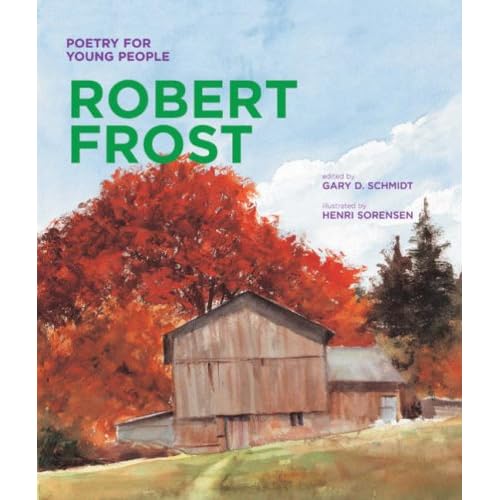
Poetry Book Review: "Poetry & Fiction"

Citation:

Frost, Robert, Gary D. Schmidt, and Henri Sorensen. 1994. Robert Frost. New York: Sterling. ISBN# 9780806906331.

Review:

Robert Frost is one of the most well recognized poets in the United States. Many young adults are familiar with this particular poet and will be able to identify with his poetry. Poetry for Young People: Robert Frost includes an assortment of poems for each season of the year (summer, autumn, winter, spring). Because of Frost’s simplicity of poetry, young adults will relate and understand the themes he writes about.

Frost uses simple themes to transpire intricate and meaningful themes to his audience. In Poetry for Young People: Robert Frost, the poems describe places and things in nature that most people relate to. What many would find not meaningful, Frost transfers it into a beautiful thing. This book shows the elegance and magnificence in mother earth.

Each poem has a detailed description showing the meanings behind the poems that Frost wrote. This gives the reader a better understanding of the details of each poem.

Ship Breaker is a 2011 Printz Award Winner announced by the American Library Association. This title focuses on a post-apocalyptic future due to a loss of cheap energy. Once these resources have been used, the world has totally changed into an ugly place. Ship Breaker encourages readers to think independently about clean energy and the future of the Earth. This particular book is more appropriate for a high school level reader. The characters in Ship Breaker are gruesome and desperate for survival in this horrible time.

These two works definitely contrast each other. Poetry for Young People: Robert Frost shows the beauty in nature, while Ship Breaker is lacking its natural environment. In a way, these two works complement each other. The environmental themes in Ship Breaker are missing the beauty in Poetry for Young People: Robert Frost.

By reading both texts, young adults will want to appreciate the world more. Poetry for Young People: Robert Frost shows how beautiful nature currently is for us. When we do not appreciate and acknowledge this advantage our future could end up like the future in Ship Breaker.
Poem: “The Pasture”

I’m going out to clean the pasture spring;
I’ll only stop to rake the leaves away
(And wait to watch the water clear, I may)
I sha’n’t be gone long.—You come too.

I’m going out to fetch the little calf
That’s standing by the mother. It’s so young
It totters when she licks it with her tongue.
I sha’n’t be gone long.—You come too.

Introducing the Poem:

The poem “The Pasture” is an introducing poem itself. Basically Frost is introducing the reader to come with him. He shows a part of his life and asks you to participate with him. This poem is very soothing and quiet. It draws the reader in and makes them want to know more.

I would introduce this poem to the class and ask them what they imagined. It would also be important to ask them how it made them feels. Since the poem has a soothing presence, I would talk about the way nature and wildlife is being used with Poetry for Young People: Robert Frost.

Next, I would introduce Ship Breaker. I would have the class read the book and then later go over certain parts of the book that they were moved by. Since this text shows an unfortunate future for our environment, I would talk to the class about how these events transpired. This conversation will bring up topics of preserving our environment.

By introducing “The Pasture” and other poems from Poetry for Young People: Robert Frost, students will be able to identify the appreciation of a healthy environment. Comparing the two books would be a great way to raise discussions and debates about our green efforts as well.

Wednesday, March 23, 2011

Poetry Book Review: "Biographical Poetry"

Citation:

Hemphill, Stephanie. 2007. Your own, Sylvia: a verse portrait of Sylvia Plath. New York: Alfred A. Knopf. ISBN#: 9780375837999.

Review:

This poetry book details the events of Sylvia Plath's life in the viewpoint of those who knew her best. Stephanie Hemphill comprises these viewpoints and creates poems that illustrate Plath's life. The poems expressed in this book show the events that took place from Plath's birth to her death.

Hemphill uses the technique of viewpoints to illustrate how Plath was viewed. In Your Own, Sylvia the points of view are from Otto Plath (father), Aurelia Plath (mother), Warren Plath (brother), Ted Hughes (husband), and many neighbors, classmates, doctors, nurses, and acquaintances.

By using these different viewpoints, the reader gains a great understanding of how Plath was viewed in her lifetime. The author writes in the style of Plath to show an authenticity. Hemphill researchers thorugh letters, journals and biographies to do so. In addition, Hemphill uses historical information that she learned from those who knew Plath. She uses this information within the poetry to give it more truth.

Another benefit to Your Own, Sylvia are the added annecdotes and information below each poem. These paragraphs show historical information about the poems written. Having this added information helps the reader to understand more about Sylvia Plath's life.

Poem: "Winter's End"

Imagining Sylvia Plath
In the style of "Edge"
February 11, 1963

She is determined, ready as a knife,
Her letters sealed.

The hall light smiles, a halo calling her
To flame. She wings into the kitchen,

Spreads mustard on their crustless bread,
Pours two pure white glasses of milk.

She kisses the children's foreheads,
Folds over their sheets.

The streetlamp clicks off.
She opens the window to dawn,

Wedges a towel under the children's door.
Righteous, happy as a rose,

She knows her place in the garden.
Her black petals curl underground.

She tidies her desk, leaves her manuscript,
Ariel and Other Poems, to the moon,

To the world of bone. The sun breaks
Like yolk. It is time.

She unlatches the over door. The gas
Fills her nostrils, sweet as blood, pungent as a sword.

Introducing the Poem:

This poem is a rendition of Sylvia Plath's "Edge". "Winter's End" is very similar to the last (rumored) poem that Plath wrote before ending her own life. The above poem shows the motions that she took in the last hours of her life.

This book is more suitable for young adults. I would introduce this poem to the class after showing "Edge" by Sylvia Plath. Next, I would open the classroom up for discussion about the two poems to talk about similarities and differences.

I would follow up with the students picking a particular poet that they are interested in and pick a specific poem. Finally, the students would be assigned a task to produce their version of the poem in the way they would view the particular theme. This follows a similar path that Hemphill took.

By introducing the poem in this way, students will be able to see how the poem can change with a different perspective. They will also be able to relate to a particular poet. This biographical poetry book is beneficial for students to read because it opens them up to the life of poets.

Monday, June 14, 2010

Competency #2: Related Blog: Hagley Archives

Hagley Library and Archives blog displays the information and exhibits at the Hagley Museum in Delaware. The library shows different pieces from their special archives on their blogspot. One post describes an exhibit entitled "Beer and Brewing History at Hagley"; it showcases historical materials that were once held at breweries in Delaware and Pennsylvania. From the blog:

"Americans continued to prefer English-style ales until the 1840s when German immigrants introduced lager beer. Fermented using a different type of yeast, lager beer is light and effervescent, a marked contrast to heavy, malty ales. Lager beer was swiftly embraced by American beer drinkers, and by 1875, there were nearly 3,000 American breweries producing over 8.7 million barrels of beer annually. Philadelphia had been a major brewing center since before the Revolutionary War, and the number of breweries in the city continued to increase; in 1890, Philadelphia was home to 91 breweries, many of which were located in the Brewerytown section of the city."


"The Joseph Stoeckle Brewing Company operated Wilmington, Delaware's Diamond State Brewery from 1872 to 1955. The brewery, which was once the city's largest, was demolished in 1962 to make way for Interstate 95 through Wilmington."

Hagley Library and Archive blog is beneficial for library science students that are seeking information about archival science. This blog provides the latest findings and exhibits that is both interesting and educational.

This Hagley Library and Archive blog was found with GoogleBlog.
This Hagley Library and Archive blog post can be found here.
This Hagley Library and Archive blog can be found here.