Showing posts with label Information Storage and Retrieval Systems. Show all posts

Wednesday, July 7, 2010

Competency #6: Browsing Search Technique in ERIC Database

Searching for: Special Archives in Special/Research Libraries.

This final search technique requires the user to randomly browse through a database to find information. In ERIC database the user can choose to "Visual Search" through information. By first entering "Archives" I am able to view at different index terms. This search is a lot like Citation Pearl Growing. ERIC database provides one of the neatest features I have ever seen for browsing:


From left to right, I was able to narrow each search further and further to find exactly what I was looking for. Also, it shows other options that you may not have thought of. Here is a specific entry:


This search most likely would normally take a lot of time to perform. Unexpectedly, this search was the most easy and efficient that I was able to encounter. Perhaps, ERIC contributed as well. This "Visual Search" was beneficial to have learned and it definitely would help users. Especially beginner users.

Competency #6: Citation Pearl Growing Search Technique in Library Literature Database

Searching for: Special Archives in Special/Research Libraries.

Using the Citation Pearl Growing search technique, I started with a known item in the Library Literature database. This search will be in the realm of Special Archives or Archival Science.
SS1 = Smart Search (Special Archives) = 208 results


Using the Citation Pearl Growing technique I decided to click on the side links : "New Search By Subject" > "Photographic Archives". By doing this, I have a specific range to choose from. This is one of the results:


From this specific entry the user can click "Photographic Archives" and Library Literature brings all the other like items for users to view. Here is another related entry:


And thirdly, we are able to find another related entry through the index links.


This technique was able to bring a specific search to a subject index. From that point, the helpful results were linked and connected to each other. This was beneficial for the user because it gives a small (but helpful) selection of information that is greatly related to each other. This takes a lot of time away from the searcher.

Competency #6: Specific Facet First Searching Technique in WorldCat Database

Searching for: Special Archives in Special/Research Libraries.

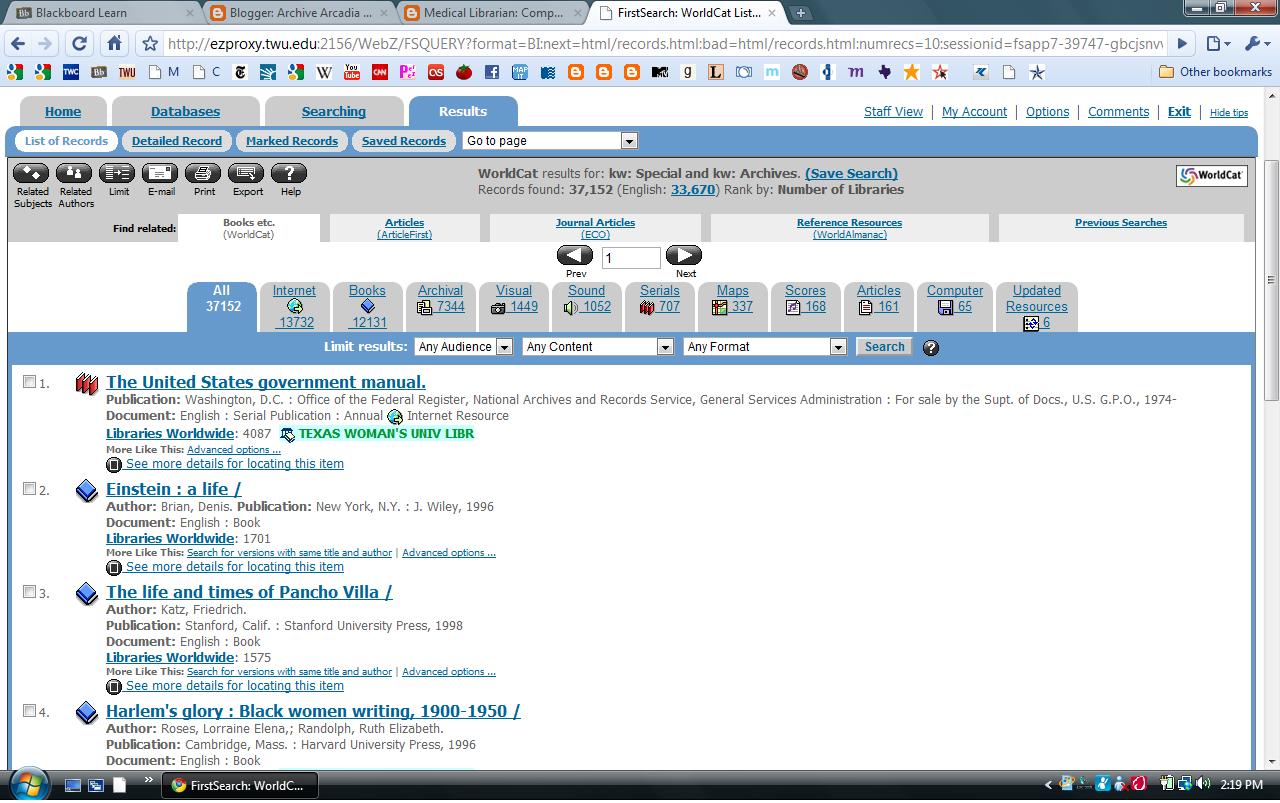
To start this Specific Facet First search, I chose "Special Archives" as the facet. By doing this, I'm hoping to find some information about how other special and research libraries archive their materials. This search could also help by locating information and examples about specific special archives.
Using WorldCat database I received over 37,000. [Too much!]
SS1= kw (Special Archives).


I decided to make the search even more specific from "Special Archives" to "Special Library Archives". This search brought over 11,000 results.
SS2 = kw (Special Library Archives).

The results related more to Special Libraries than to their Archives. Therefore, this specific facet first search has brought back broad results. I needed to make a more specific search. The previous two searches used a keyword search. This third search will be "Special Archives" under the subject search in WorldCat.
SS3 = su (Special Archives).


This search brought 1,348 results that were helpful. They were more specific and less broad. This one in particular was a great resource.


This database encompasses a lot of information and files. The Specific Facet First search technique was a little difficult with WorldCat. Since, so much information is in this database, the user needs to use various specific words in order to obtain a good result.

Sunday, July 4, 2010

Competency #6: Building Block Search in ASC Database

Searching for: Special Archives in Special/Research Libraries.

Using the building block technique when searching helps to find accurate results. Let's say I am trying to find articles about libraries or librarians that have special archives or special archiving systems. The building block approach can break down the search statement:

SS1: SU(library OR Librarian) AND (Special Archives OR Archive System).

SS1= NO RESULTS.

SS2: (library OR Librarian) AND (Special Archives OR Archive System).


SS2 yields 24 results and SS1 reached 0 results. SS1 took the exact same components as SS2 but I searched with a "subject" search. This, of course was too narrow so I widened the search to "all fields". The second search was successful.


I also added "archivist" to the search as a building block component and it helped bring in more specific results.
By using the building block technique I was able to find a great article from the Journal of the Society of Archivists about the production, location, changes and standards of archival systems in the Netherlands. The article is a match from the search statement.

Wednesday, June 9, 2010

Competency #1: Blogging Purpose

Archive Arcadia is a graduate assignment for an Information Storage and Retrieval Systems course implemented to further the understanding and discovery of online information. In particular, this blog is specifically relating to archival science within the walls of special and research libraries.

It's intended use is purely academic and shares information pertaining to research library archival science for encouraged viewers. Archival science is explored by collection, handling, retrieving, and preserving the use of special documents.