Showing posts with label Imagination. Show all posts

Thursday, April 21, 2011

Poetry Book Review: "Janeczko Poetry"

Citation:

Janeczko, Paul B., and Christopher Raschka. 2009. A foot in the mouth: poems to speak, sing, and shout. Somerville, Mass: Candlewick Press. ISBN# 9780763606633.

Review:

A Foot in the Mouth is a great poetry book for children to learn about the many sounds of poetry. Many of the poems in this book are great for students to read out loud and enjoy. Janeczko compiles a group of poems that introduces humor and play-on words that children will enjoy.

This book is grouped into different types of performance poetry. These include “Poems for One Voice”, “Tongue Twisters”, “Poems for Two Voices”, “List Poems”, and “Poems for Three Voices”, “Short Poems”, “Bilingual Poems”, “Rhymed Poems”, “Limericks”, and “Group Poems”.

A Foot in the Mouth also displays a great array of poets from Georgia Heard to Walt Whitman to William Shakespeare. What is great about this poetry book is that there are so many types of poetry and poets to introduce.

This poetry book is also beneficial because it will invite children to become more vocal. The poetry is exciting and fun for students to learn from. A Foot in the Mouth illustrates poetry with great rhymes and beats that will encourage students to participate.

Poem: “Anna Elise”
Anonymous

Anna Elise, she jumped with surprise;

The surprise was so quick, it played her a trick;

The trick was so rare, she jumped in a chair;

The chair was so frail, she jumped in a pail;

The pail was so wet, she jumped in a net;

The net was so small, she jumped on the ball;

The ball was so round, she jumped on the ground;

And ever since then she’s been turning around.

Introducing the Poem:

“Anna Elise” has a repetitious beat that continues to grow faster as you are reading it. This is a great poem because it has that element of ‘what will happen next?’ that children adore. In addition, it has fun rhymes and repeating words that add to its charm.

I would introduce this poem by first reading it to the class enthusiastically. At the beginning of the poem I would start slowly and read faster until the end of the poem. Once I reach the last line and I read it slowly like the first. This gives a fun nature to the poem.

Next, I would get a volunteer to read the poem. Furthermore, I would see if they would like to read it out loud differently that how I did. Because there is some rhyming in the middle on each line, the poem could be broken up more. Children may want to experiment with different ways of reciting “Anne Elise”. Students might like to recite it like a rap song.

A Foot in the Mouth has many other poems that can be introduced to students. This is a great book to introduce poetry to children because of its exciting factor. The poems are fun and children will be drawn to them.

Poetry Book Review: "Poetry & Fiction"

Citation:

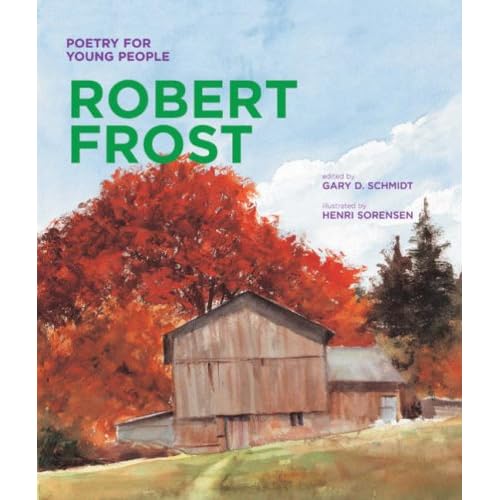
Frost, Robert, Gary D. Schmidt, and Henri Sorensen. 1994. Robert Frost. New York: Sterling. ISBN# 9780806906331.

Review:

Robert Frost is one of the most well recognized poets in the United States. Many young adults are familiar with this particular poet and will be able to identify with his poetry. Poetry for Young People: Robert Frost includes an assortment of poems for each season of the year (summer, autumn, winter, spring). Because of Frost’s simplicity of poetry, young adults will relate and understand the themes he writes about.

Frost uses simple themes to transpire intricate and meaningful themes to his audience. In Poetry for Young People: Robert Frost, the poems describe places and things in nature that most people relate to. What many would find not meaningful, Frost transfers it into a beautiful thing. This book shows the elegance and magnificence in mother earth.

Each poem has a detailed description showing the meanings behind the poems that Frost wrote. This gives the reader a better understanding of the details of each poem.

Ship Breaker is a 2011 Printz Award Winner announced by the American Library Association. This title focuses on a post-apocalyptic future due to a loss of cheap energy. Once these resources have been used, the world has totally changed into an ugly place. Ship Breaker encourages readers to think independently about clean energy and the future of the Earth. This particular book is more appropriate for a high school level reader. The characters in Ship Breaker are gruesome and desperate for survival in this horrible time.

These two works definitely contrast each other. Poetry for Young People: Robert Frost shows the beauty in nature, while Ship Breaker is lacking its natural environment. In a way, these two works complement each other. The environmental themes in Ship Breaker are missing the beauty in Poetry for Young People: Robert Frost.

By reading both texts, young adults will want to appreciate the world more. Poetry for Young People: Robert Frost shows how beautiful nature currently is for us. When we do not appreciate and acknowledge this advantage our future could end up like the future in Ship Breaker.

Poem: “The Pasture”

I’m going out to clean the pasture spring;
I’ll only stop to rake the leaves away
(And wait to watch the water clear, I may)
I sha’n’t be gone long.—You come too.

I’m going out to fetch the little calf
That’s standing by the mother. It’s so young
It totters when she licks it with her tongue.
I sha’n’t be gone long.—You come too.

Introducing the Poem:

The poem “The Pasture” is an introducing poem itself. Basically Frost is introducing the reader to come with him. He shows a part of his life and asks you to participate with him. This poem is very soothing and quiet. It draws the reader in and makes them want to know more.

I would introduce this poem to the class and ask them what they imagined. It would also be important to ask them how it made them feels. Since the poem has a soothing presence, I would talk about the way nature and wildlife is being used with Poetry for Young People: Robert Frost.

Next, I would introduce Ship Breaker. I would have the class read the book and then later go over certain parts of the book that they were moved by. Since this text shows an unfortunate future for our environment, I would talk to the class about how these events transpired. This conversation will bring up topics of preserving our environment.

By introducing “The Pasture” and other poems from Poetry for Young People: Robert Frost, students will be able to identify the appreciation of a healthy environment. Comparing the two books would be a great way to raise discussions and debates about our green efforts as well.

Wednesday, March 23, 2011

Poetry Book Review: "Social Studies Poetry"

Citation:

Volavková, Hana. 1993. I never saw another butterfly: children's drawings and poems from Terezín Concentration Camp, 1942-1944. New York: Schocken Books. ISBN#: 0805241159.

Review:

This poetry book examines the horrific past of the concentration camp of Terezin from 1942 - 1944. I Never Saw Another Butterfly is a true work of art because it preserves the history of children with the concentration camp with poetry and drawings.

Many of the poems are about the hopes and fears of the children there. They wonder when they will get to return to their homes. The pictures show the past as they remember it, as well as, what they see happening at the camps. Their poetry examines the deaths that they witness and the abuse upon them. I Never Saw Another Butterfly is an award winning book that many will be influenced by.

This social studies poetry book is a great historical tool to teach children about the past, in a perspective that they can understand. Before the poetry begins there is a brief historical sections describing the conditions of the children within the book. This poetry book is not suitable for all ages of children. I would only introduce this book to young adults.

Many of the poems are anonymous because the children never signed their names. The poetry in this book is of high quality, not for literary reasons, but for the experience of these children. There is a raw emotion that is apparent in the pictures and words.


Poem: "I Am a Jew" by Franta Bass

I am a Jew and will be a Jew forever.
Even if I should die from hunger,
never will I submit.
I will always fight for my people,
on my honor.
I will never be ashamed of them,
I give my word.

I am proud of my people,
how dignified they are.
Even though I am suppressed,
I will always come back to life.


Introducing the Poem:

This poem promotes so many topics with social studies and poetry. It shows history, experience, power through words, life lessons, culture, and poetic imagery.

I would introduce this poem with a pairing of books. In high school, most students read Anne Frank: The Diary of a Young Girl. I would pair this poem before assigning the book reading. Another great book about this occurrence is Night by Elie Weasel. (This was assigned in my high school class.) I would assigned one of these great works and talk about the book as the students are progressing.

After the books are finished I would reintroduce the poem "I Am a Jew" to the class and open it up for discussion. Finally, I would read more examples from I Never Saw Another Butterfly to show the students more personal examples from this horrible historical occurrence.

By giving first hand examples from critically acclaimed works, nobel prize winning works, and young adult poetry, these young adults will have a great understanding to these historical times.

Poetry Book Review: "Science Poetry"

Citation:

Hopkins, Lee Bennett, and Virginia Halstead. 1999. Spectacular science: a book of poems. New York: Simon & Schuster Books for Young Readers. ISBN# 0689812833

Review:

This book of poems shows science wonders that children learn in the classroom. Most of these lessons and topics are not fully understood by children and are illuminated through the poetry. Children will benefit from the fun and involving poetry about various science related topics.

Spectacular Science explains complicated science topics such as seeds, microscopes, light, magnetism, dinosaur bones, rocks, metamorphosis, snowflakes, wind, stars and skies. These areas of science are being taught through poetry in this book. The reader will not realize that these lessons are within each line. This will entice children with learning science through poetry in a fun way.

This science poetry books also shows works from a variety of great poets like Lilian Moore, Aileen Fisher, Lee Bennett Hopkins, Carl Sandburg, David McCord, Valerie Worth and more. These different poet bring different poetry styles for different science subjects. This diverse creativity enhances the book and keeps you excited for the next poem.

The visual imagery in Spectacular Science is great for children. Poets use different rhyming techniques and stanza lengths. However, all poets show science in a fun, information way. Each page has vivid illustrations that enhance the science poetry.

Some of the topics in this book are really relatable. I personally found some of the poems to discuss science topics that even I wonder about! These topics are lifelong science wonders that children and adults will be curious about.


Poem: "The Seed" by Aileen Fisher

How does it know,
this little seed,
if it is to grow
to a flower or weed,
if it is to be a vine or shoot,
or grow to a tree
with a long deep root?
A seed is so small,
it stores up all
of the things it knows?


Introducing the Poem:

This example demonstrates some thing simple and complex, such as seeds. Growing plants is an everyday occurrence with nature and something that could also qualify as a phenomenon. (Especially for children.)

I would introduce this poem near springtime when plants, flower, etc are starting to grow. I might even demonstrate planting seeds and watching them grow. This usually takes place in science classes for children.

First, I would let the children learn about planting seeds and nurturing them to grow. Next, I would introduce the poem and ask the children how they think that the seed grows. Once the seeds grow into plants and flowers the children well have an example to pair the poetry with.

By introducing the poem with an actual science lesson children will have a paired understanding of both poetry and science. This is a great way for them to learn because it illustrates imagination, curiosity, poetry, science, and demonstration.

"The Seed" expresses questions that are similar to the wonders of a child. Introducing this poem will create imagination for children.

Thursday, February 17, 2011

Poetry Book Review: "Multicultural Poetry"

Citation:

Mora, Pat, and Rafael López. 2007. Yum! mmmm! qué rico!: Americas' sproutings. New York: Lee & Low Books Inc. ISBN: 978154302711.

Review:

Pat Mora uses one haiku for each poem; each haiku describes a specfic food that is native to the Americas. Mora brilliantly uses food to show multicultural poetry.

These foods include blueberry, chile, chocolate, corn, cranberry, papaya, peanut, pecan, pineapple, potato, prickly pear, pumpkin, tomato and vanilla. In addition, with each food hiaku is a passage describing the origins of the food and unique facts. These passages are beneficial for teachers and parents that would want to enhance the understandings of a particular food.

This poetry book is a great example of multicultural poetry because it displays spanish words with english words. These include "la cocina"(kitchen), "los dulces"(sweets), "la luna"(moon) and "que rico"(delicious). Including these words creates a mystery for some children and teaches them new words.

While there is no appearant rhyme, Mora uses consonance and alliteration throughout some of her haiku. For example, "thick prickly skin, inside". This makes each haiku fun to recite and easy to read for children. Mora's literary techniques when writing about food create a great visual imagery.

The illustrations by Rafael Lopez are very vivid and convey a message of happiness. These bright images mixed with haiku about food welcomes a joyous reaction with children.


Poem: "Peanut"

Smear nutty butter,
then jelly. Gooey party,
my sandwich and me.


Introducing the Poem:

Mora uses alliteration and consonance in this particular poem with "nutty butter" and "jelly. Gooey party". She takes the poem about peanuts and translates it into something a child would recognize: a peanutbutter and jelly sandwich.

The passage on the side states how peanuts dervive from South America along with other facts. It also indicates that March is National Peanut Mouth. Introducing this poem during March would be a great way to show the poem.

Other foods within this book correspond to National Month celebrations. This particular poem could be introduced at the beginning of March when children are celebrating different aspects of the month. I would recite the poem and talk about food to the children.

There are many poems about food in this book that could be introduced to cihldren before a social studies lesson. I would also read one with a few spanish words and then translate the words for them. By introducing the poetry this way, it would be a great segway to learning other spanish words or social studies topics.

Friday, January 21, 2011

Poetry Book Review: "Hopkins Collection"

Citation:

Hopkins, Lee Bennett, and Marcellus Hall. 2009. City I love. New York: Abrams Books for Young Readers in association with the Field Museum. ISBN: 9780810983774.

Review:

Hopkins uses many techniques with her poetry. In City I Love, Hopkins uses different aspects of cities from all around the word to display various exciting themes. With her descriptive words she expresses city features such as skyscrapers, taxis, subways, etc. This poetry book shows different elements from famous cities that children will be able to identify with. Hopkins shows these big city elements with simple one-word poem lines. This poetry book helps students to connect with different environments, people and places.

Excerpt: "City Lights"

Blazing lights

flicker
flash
glitter
gleam
twinkle
sparkle
bedazzle
beam

so

brilliantly
bright.

Reasons
why
city
stays
awake
all
night.

Introducing the Poem:

With the illustrations behind this poem, children will be able to easily connect and imagine what the poetry is trying to read to them. The child's imagination will definitely open up. This would be a great poem to show to the students while they are learning about different cultures or places around the world. Children will be excited about different people and the different places they come from. Many of these poems can illustrate happiness within something mysterious.

Poetry Book Review: "School Poetry"

Citation:
Prelutsky, Jack, and Doug Cushman. 2006. What a day it was at school!: poems. New York: Greenwillow Books. ISBN: 9780060823351.

Review:
What a Day it Was at School! is a fun and exciting poetry book detailing the different elements of school. The main character is illustrated as a cat instead of a child which opens up the imagination. Different aspects described are doing homework, going on field trips, the cafeteria, show and tell, and different subjects within the curriculum. What a Day it Was at School! also gives detailed illustrations that are slightly exaggerated from normal life; this creates more imagination to the reader. There is a simple rhythm which gives an easy meter for reading. Some lines include alliteration which is fun for kids. This book of poetry is also very descriptive which gives senses such as sight and sound. This poetry book is a fluent story book; Each page shows a fun and excited part of going to school.

Excerpt: "I Drew a Yellow Unicorn"

I drew a yellow unicorn,
Complete with polka dots,
A seven-legged elephant,
A pig with purple spots,
The sky was full of furry fish
All flying upside down.
An octopus was dressed in plaid,
A camel wore a crown.

I drew a green rhinoceros
That floated on the breeze,
Some bees as big as basketballs,
And blue spaghetti trees.
The penguins wore pajamas,
And a carrot flew a kite...
My teacher says it's beautiful-
I think my teacher's right.

Introducing the Poem:
I would show this poem from What a Day it Was at School! to the children because it opens up the child's imagination. It also keeps them excited about school. I chose the artistic poem from the rest (math, science, etc.) because it describes how the character in the poem is artistic and inventive. This would be a great poem to present before art class or a time devoted to arts and crafts for kids. It could also be shown to increase the reader's imagination. There is also a poem that describes going to the library which would be a great way to introduce the children to the library. At the end of What a Day it Was at School! is a poem about kids writing poems. This poetry book has many aspects of school life that are helpful to children and would open their minds to having fun at school.